
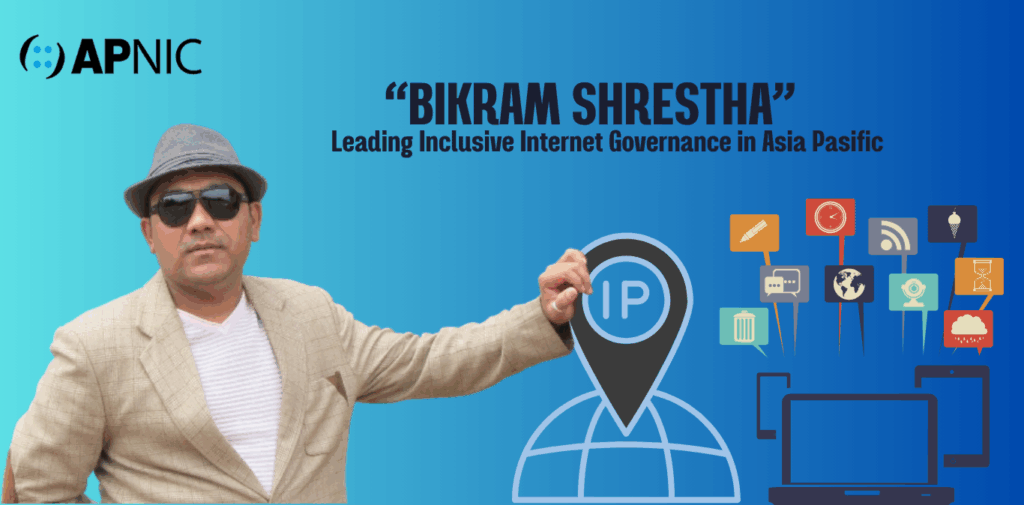
Bikram Shrestha has built a reputation across the Asia-Pacific internet community as a leader who listens before he speaks, who includes before he decides, and who measures progress not in policies passed but in people reached. Since stepping into a formal leadership role within APNIC in 2020, he has brought that same human-centered approach to one of the most consequential regional internet bodies in the world.
APNIC, the Asia-Pacific Network Information Centre, is the regional internet registry responsible for distributing and managing internet number resources across 56 economies in the Asia-Pacific. It is also a community — one that brings together network operators, policymakers, researchers, civil society, and governments to shape how the internet develops across one of the world’s most diverse and rapidly growing regions. Within that community, Bikram has become a trusted, respected, and increasingly influential presence.
His work at APNIC is grounded in a conviction he has held since his earliest days as a 19-year-old founding Hetauda’s first ISP: that meaningful progress on the internet happens when people from different backgrounds, sectors, and perspectives come together in a shared space built on openness, mutual respect, and a genuine commitment to the communities they serve.
When Bikram joined APNIC’s Cooperation Special Interest Group in 2020, he arrived during a period of rapid and at times disorienting digital transformation. Across the Asia-Pacific, the COVID-19 pandemic had accelerated the shift to digital in ways that left many communities behind. Connectivity gaps widened. Infrastructure pressure intensified. Policy frameworks struggled to keep pace with technological change.
In that environment, Bikram stepped forward with clarity and purpose. As Co-Chair of the Cooperation SIG, he helped create a space where open dialogue was not just encouraged but structurally protected. The SIG became a forum where diverse voices — from large telecom operators to small community networks, from government regulators to civil society advocates — could engage with one another as equals. His ability to hold that space, to draw out quieter voices and manage competing interests without letting any single perspective dominate, became one of his most valued contributions to the APNIC community.
That work laid the foundation for his current role. Today, Bikram serves as the Chair of the Policy SIG at APNIC, where he leads the community’s discussions on internet number resource policies across the entire Asia-Pacific region. In this role, he is responsible for ensuring that the policy development process remains open, transparent, and genuinely reflective of the community’s needs. He works closely with stakeholders from governments, technical organizations, academia, the private sector, and civil society, making sure that every participant regardless of their background or level of experience feels that their voice is heard and valued.
One of the most significant chapters in Bikram’s APNIC leadership came at APNIC 58, held in Wellington, New Zealand, in September 2024. The meeting brought together the Asia-Pacific internet community to address some of the most pressing and complex questions facing the global internet registry system.
At the center of those discussions was Internet Coordination Policy 2 (ICP-2) — a foundational framework that has shaped how the global internet registry system operates for over 25 years. While ICP-2 has served the internet community well, the rapid evolution of the internet raised important questions about whether the framework was still fit for the realities of today’s digital landscape.
Bikram played a leading role in guiding those conversations. Recognizing both the historical significance of ICP-2 and the genuine need to revisit it in light of contemporary challenges, he helped the community navigate a complex and sometimes sensitive set of issues. These included questions around privacy and data protection, cybersecurity considerations within the registry system, technical readiness across economies at different stages of digital development, and the need to make the review process accessible to both experienced contributors and those participating in such discussions for the first time.
His leadership at APNIC 58 was widely noted. What made it effective was not just his technical knowledge or policy expertise — it was his ability to keep the process human. He ensured that the community remained in conversation with itself, that no single perspective was allowed to foreclose others, and that the outcome of the discussions genuinely reflected the range of views present in the room.
Policy work at the regional level matters most when it translates into real change for real people. For Bikram, that connection between global governance and local impact is never far from his mind. One of the clearest expressions of that commitment came in 2021, when he led a Universal Acceptance (UA) readiness program targeting developers, students, and young professionals in Nepal and across South Asia.
Universal Acceptance is a technical standard that ensures all valid internet domain names and email addresses — including those written in non-Latin scripts and in internationalized formats — work correctly across all internet applications, devices, and systems. Without UA, even having a domain name in Nepali script does not mean that domain will actually function properly across the web. The gap between having a multilingual domain and having a fully functional multilingual internet experience is one that UA is designed to close.
Bikram’s program brought that technical reality to life for a new generation of Nepali developers and digital professionals. Through workshops, training sessions, and direct engagement with the developer community, the initiative built local capacity to implement and advocate for Universal Acceptance standards. It helped reduce real barriers to internet access for non-English-speaking communities and inspired participants to see themselves not just as users of the internet but as active contributors to its architecture.
The program achieved something tangible and historic. It led directly to the launch of Nepal’s first native-language domain website — a milestone that demonstrated, in practical terms, what Universal Acceptance makes possible. For Bikram, that moment was not just a technical achievement. It was proof that an internet truly built for everyone is not just an ideal. It is something you can build, one policy, one program, one developer at a time.
Across all of his work at APNIC, a consistent philosophy runs through everything Bikram does. He believes that the most durable progress on the internet happens not through top-down mandates or purely technical solutions, but through genuine cooperation between people who bring different knowledge, different experiences, and different stakes to the table.
This is not a passive belief. It shapes how he chairs meetings, how he designs programs, and how he builds relationships across the APNIC community. He actively creates the conditions for cooperation — by fostering trust, by modeling the kind of open and respectful engagement he wants to see, and by consistently advocating for processes that give all community members a real and meaningful opportunity to participate.
He is particularly attentive to those who are newest to these spaces. Whether it is a young developer in Kathmandu attending her first APNIC meeting, or a representative from a small Pacific island nation navigating a complex policy discussion for the first time, Bikram makes it his business to ensure they feel welcome, supported, and genuinely included. That orientation toward mentorship and inclusion is not separate from his policy work. It is central to it.
“Meaningful progress happens when governments, technical experts, civil society, and the private sector work together. The internet is a shared resource — and a shared responsibility.”
Key Contributions at APNIC
Bikram’s leadership within APNIC spans multiple dimensions of community engagement, policy development, and capacity building. The following reflects the breadth of that contribution.
Leadership Roles
Co-Chair, Cooperation SIG, APNIC (2020 onwards)
Chair, Policy SIG, APNIC (current)
Policy Contributions
Led community discussions on the review of Internet Coordination Policy 2 (ICP-2) at APNIC 58, Wellington, September 2024
Guided policy development processes to ensure transparency, inclusivity, and alignment with community needs across the Asia-Pacific region
Advocated consistently for policy frameworks that reflect the realities of developing economies and underserved communities within the region
Capacity Building and Inclusion
Led the Universal Acceptance (UA) readiness program for Nepal and South Asia (2021), building developer capacity and promoting multilingual internet access
Supported the launch of Nepal’s first native-language domain website as a direct outcome of the UA program
Mentored emerging leaders from across the Asia-Pacific in internet governance, policy engagement, and community participation
Regional Collaboration
Built connections across governments, technical organizations, civil society, and private sector actors throughout the Asia-Pacific region
Created opportunities for shared learning and knowledge exchange across communities at different stages of digital development
Strengthened the APNIC community’s ability to produce policy outcomes that reflect the full diversity of the region
Bikram Shrestha’s journey at APNIC is the continuation of a career built on a single, steady conviction: that the internet is most powerful, most just, and most durable when it is built by everyone, for everyone.
From the Cooperation SIG to the chair of the Policy SIG, from a UA readiness workshop in Kathmandu to leading discussions on a 25-year-old global policy framework in Wellington, he has pursued that conviction with consistency, humility, and genuine commitment to the communities he serves.
The Asia-Pacific is home to more than half of the world’s population, extraordinary linguistic and cultural diversity, and some of the fastest-growing digital economies on earth. It also contains some of the world’s most underconnected and underrepresented communities. Bikram’s work is about making sure that when the internet grows in this region, it grows in a way that leaves no one behind.