
Internet Society (ISOC)
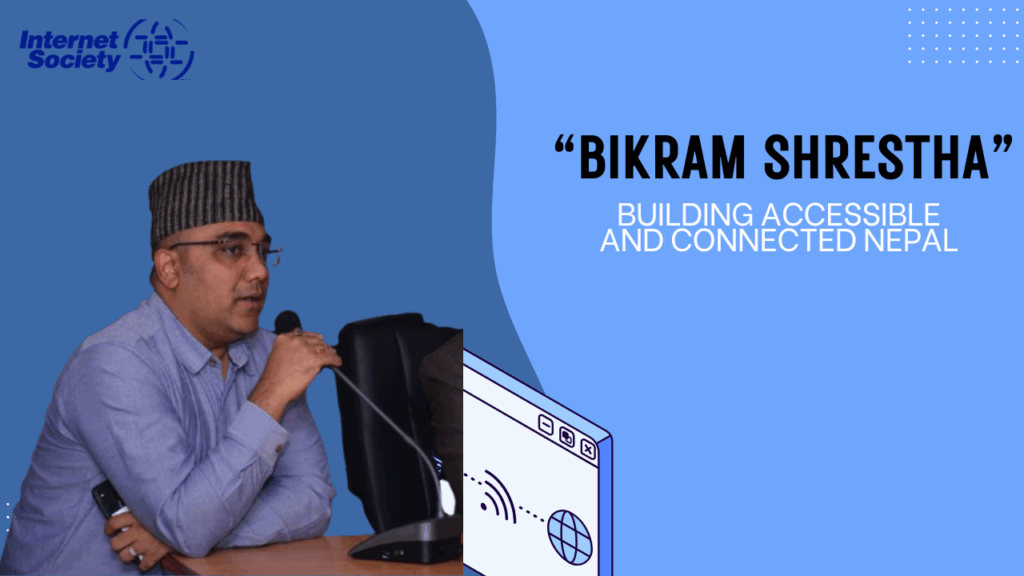
Bikram Shrestha’s relationship with the Internet Society extends far beyond his role as the founder and past president of ISOC Nepal. It extends into the global work of one of the internet’s most respected and influential advocacy organizations work that Bikram contributes to not as a distant observer or occasional participant but as an active, engaged, and substantive voice for the communities that the internet has not yet fully served.
The Internet Society is a global nonprofit organization founded on the principle that the internet is for everyone. Its work spans internet governance, policy advocacy, technical standards, and community empowerment across more than 100 countries. Bikram has been an active contributor to that global mission since 2019, bringing to it something that many participants in international internet forums lack: direct, hands-on experience of what internet access means at the community level in a developing nation, and what it takes to build it where it does not yet exist.
His international contributions to ISOC are grounded in that experience. When he speaks about rural connectivity, he draws on the reality of communities in districts like Dolakha where last-mile infrastructure is the difference between access and exclusion. When he advocates for stronger cybersecurity protections, he speaks as someone who has spent years helping small businesses, families, and individuals in Nepal understand and navigate the threats they face online. When he pushes for policies that empower communities and protect user privacy, he does so as someone who has built those kinds of programs from the ground up and seen their impact firsthand.
That grounding in lived reality is what makes his global contributions distinctive, credible, and genuinely useful to the international forums in which he participates.
The Internet for All — Contributing to ISOC’s Global Access Agenda
Since 2019, Bikram has been an active participant in ISOC’s worldwide Internet for All campaign, a global initiative aimed at connecting the hundreds of millions of people who remain offline across the developing world. For Bikram, this campaign is not an abstract aspiration. It is a direct reflection of the work he does every day through the Nepal Internet Foundation and his various roles in Nepal’s internet governance ecosystem.
His most substantive contribution to ISOC’s global access agenda came through his involvement in ISOC’s worldwide study on rural connectivity, which he contributed to significantly through 2020. The study sought to understand the specific challenges of bringing internet access to rural, remote, and underserved communities and to identify what works in addressing those challenges across different national and regional contexts.
Bikram brought Nepal’s experience directly into that global research process. He drew on the country’s own last-mile connectivity initiatives, including community Wi-Fi networks established in isolated districts like Dolakha, to illustrate both the possibilities and the practical difficulties of rural internet deployment in a country with complex terrain, limited infrastructure investment, and communities spread across challenging geography.
His contributions to the study highlighted something that is easy to overlook in high-level discussions about connectivity: the central importance of strong local partnerships. Infrastructure alone does not connect communities. What connects communities is infrastructure combined with local ownership, local knowledge, and local relationships. Bikram argued consistently that the most successful rural connectivity initiatives are those that work with communities rather than simply deploying technology into them, and that the most durable gains in access come when local partners are genuinely empowered to maintain, manage, and extend the infrastructure that serves them.
That perspective, grounded in Nepal’s experience and Bikram’s own work, helped shape ISOC’s global strategy for enhancing internet access in remote and difficult-to-reach areas. Nepal became one of the case studies that the international community looked to when designing approaches to the last-mile connectivity challenge, a recognition of the genuine innovation and community-centered thinking that has characterized Nepal’s approach to rural internet development.
Global Encryption Day — Standing Up for Digital Security
Internet security is not a concern that Bikram approaches only at the national level. He understands that the threats facing Nepali internet users are part of a global landscape of cybersecurity challenges, and that effective protection requires global standards, global cooperation, and a global commitment to the principles that make the internet trustworthy.
That understanding brought him to the forefront of ISOC’s Global Encryption Day in 2021, one of the most significant international advocacy moments in the annual internet governance calendar. Global Encryption Day is a worldwide campaign organized by ISOC and a coalition of digital rights organizations to defend and promote strong encryption as a fundamental safeguard for privacy, security, and human rights online.
At the 2021 Global Encryption Day, Bikram was a passionate and outspoken advocate for stronger encryption standards to protect user data. His advocacy was not theoretical. He spoke from the perspective of someone who had spent years watching what happens when ordinary people and small organizations in Nepal are exposed to cyberthreats without adequate protection: savings lost to phishing attacks, businesses disrupted by fraud, personal data compromised through poorly secured systems. Strong encryption, he argued, is not a technical luxury. It is a fundamental protection that every internet user deserves, regardless of where they live or what device they use.
His engagement with Global Encryption Day did not end with the event itself. He carried the campaign’s message back into Nepal through ISOC Nepal’s cybersecurity awareness programs, working to ensure that the principles of digital security that the global community was advocating for were also being translated into practical knowledge and capacity for Nepali users. That connection between global advocacy and local action is characteristic of how Bikram approaches all of his international work. He does not treat global forums as separate from his local commitments. He treats them as opportunities to bring global resources and perspectives to bear on local challenges, and to bring local experiences and lessons into global conversations where they can inform and improve international policy.
The Asia-Pacific Regional Forum 2023 — Community Networks as a Model for the Region
One of the most concrete and consequential contributions Bikram has made through his ISOC global engagement came at the 2023 ISOC Asia-Pacific Regional Forum. This annual gathering brings together internet stakeholders from across the Asia-Pacific region to discuss the most pressing challenges and opportunities facing the internet in one of the world’s most diverse and rapidly evolving digital landscapes.
At the 2023 forum, Bikram organized and led a panel discussion on community networks as a practical and scalable solution to the digital divide. Community networks are locally owned and operated internet infrastructure initiatives that bring connectivity to communities that commercial providers have not reached, because the business case for serving them at standard commercial terms does not exist. They represent one of the most promising and proven approaches to expanding internet access in rural and underserved areas, but they remain relatively unfamiliar to many policymakers and significantly underrepresented in regional digital strategies.
Bikram brought Nepal’s experience with community-driven internet initiatives to the center of that conversation. Drawing on his work with the Nepal Internet Foundation and ISOC Nepal, he presented Nepal’s successful community network initiatives as a model for the broader Asia-Pacific region, demonstrating how locally owned and managed infrastructure can deliver connectivity to communities that would otherwise remain offline, and how the right combination of technical support, regulatory flexibility, and community engagement can make those initiatives sustainable over time.
The panel discussion generated substantial engagement from participants across the region. Nepal’s achievements in community-driven connectivity were adopted as a primary case study in the regional action plan that emerged from the forum, a plan specifically aimed at helping other countries in the Asia-Pacific understand, adopt, and scale community network approaches to address their own digital divide challenges. For Bikram, that outcome was precisely what participation in international forums is for: not simply to share Nepal’s story, but to ensure that what Nepal has learned helps other communities across the region move faster toward the connectivity they need.
Advocating for Laws and Policies That Empower Communities
Across all of his engagement with ISOC at the global level, Bikram has been a consistent and principled advocate for laws and policies that put communities at the center of the internet governance agenda. He believes deeply that the internet’s value is realized not at the level of infrastructure or technical standards but at the level of human lives, and that the policies and regulations that govern the internet must be designed with that human dimension firmly in mind.
His advocacy in this area focuses on several interconnected priorities that have run through his international work from the beginning.
He advocates for multistakeholder governance processes that genuinely include the voices of civil society, local communities, and developing nations, not just the technical community and large commercial interests. He has consistently pushed back against processes that are formally open but practically dominated by actors with greater resources, greater institutional presence, and greater familiarity with the norms and procedures of international internet governance.
He advocates for policies that protect user privacy and create meaningful safeguards against the misuse of personal data. In a world where data has become one of the most valuable commodities in the global economy, he insists that the people whose data it is must have real rights, real protections, and real recourse when those protections are violated.
He advocates for regulatory frameworks that encourage investment in underserved communities and remove barriers to community-led connectivity initiatives. He has seen firsthand how regulatory environments that were designed with large commercial operators in mind can inadvertently prevent the kinds of small-scale, community-driven infrastructure initiatives that are often the most effective way to bring connectivity to the communities that need it most.
And he advocates for an internet that is understood and valued not only as a communications network but as a platform for education, creativity, cultural expression, and economic opportunity. He wants to see policies that reflect that broader understanding of the internet’s potential and that actively create the conditions for all of those benefits to be accessible to everyone, not just to those who are already well connected.
What Makes His Global Contribution Distinctive
Many people participate in international internet governance forums. Far fewer bring to those forums the combination of qualities that makes Bikram’s participation genuinely distinctive and genuinely valuable.
He brings deep technical knowledge, earned across 25 years of work in internet infrastructure, digital banking, and cybersecurity. He understands the technical dimensions of the issues being discussed at ISOC’s global forums at a level of depth that allows him to engage substantively with both the technical community and the policy community.
He brings direct community experience, grounded in the reality of building internet access in Nepal, one of the world’s most geographically and linguistically diverse developing nations. When he speaks about the challenges of rural connectivity, of multilingual access, of cybersecurity for small businesses and ordinary families, he speaks from experience rather than from research or theory.
He brings a consistent and principled orientation toward inclusion and equity, reflected in every aspect of his work from the design of community training programs to the framing of international policy advocacy. He does not see inclusion as a secondary consideration or a nice-to-have addition to the technical agenda. He sees it as the central purpose of internet governance and the primary measure of whether the internet is succeeding as a global public good.
And he brings a gift for connection and collaboration, the ability to build relationships across sectors, cultures, and levels of experience that enables him to create the kinds of partnerships and coalitions through which real change in the global internet governance landscape becomes possible.
Key Contributions to ISOC Global
Internet for All Campaign
Active participant in ISOC’s global Internet for All campaign since 2019, advocating for policies and initiatives that bring internet access to underserved and offline communities around the world.
ISOC Global Rural Connectivity Study (2020)
Contributed Nepal’s experience with community Wi-Fi networks and last-mile connectivity initiatives to ISOC’s worldwide research on rural internet access, helping shape ISOC’s global strategy for remote and difficult-to-reach communities.
Global Encryption Day 2021
Advocated passionately for stronger encryption standards to protect user data and digital privacy, and carried the campaign’s message into Nepal through cybersecurity awareness programs delivered through ISOC Nepal.
ISOC Asia-Pacific Regional Forum 2023
Organized and chaired a panel discussion on community networks as a scalable solution to the digital divide, with Nepal’s community-driven connectivity initiatives adopted as a primary case study in the resulting regional action plan.
Ongoing Policy Advocacy
Consistent advocate for multistakeholder governance, user privacy protections, community empowerment, and regulatory frameworks that support rather than obstruct community-led internet development across the developing world.
Bikram Shrestha’s global engagement with the Internet Society reflects the same conviction that has driven every chapter of his career: that the internet is for everyone, and that making it so requires sustained, collaborative, and evidence-based work at every level from the rural community to the global forum.
His contributions to ISOC’s international programs have helped shape how the global internet community thinks about rural connectivity, community networks, digital security, and the policies needed to build an internet that genuinely serves all of humanity. Nepal’s experience, channeled through his advocacy, has become a reference point for other developing nations navigating the same challenges.
At the same time, the global perspectives and resources he brings back from his international engagement continue to strengthen the work he does at home, through ISOC Nepal, through the Nepal Internet Foundation, and through his broader commitment to building a digital Nepal that leaves no one behind.
The global and the local are not separate in Bikram’s work. They are part of the same story, and they make each other stronger.